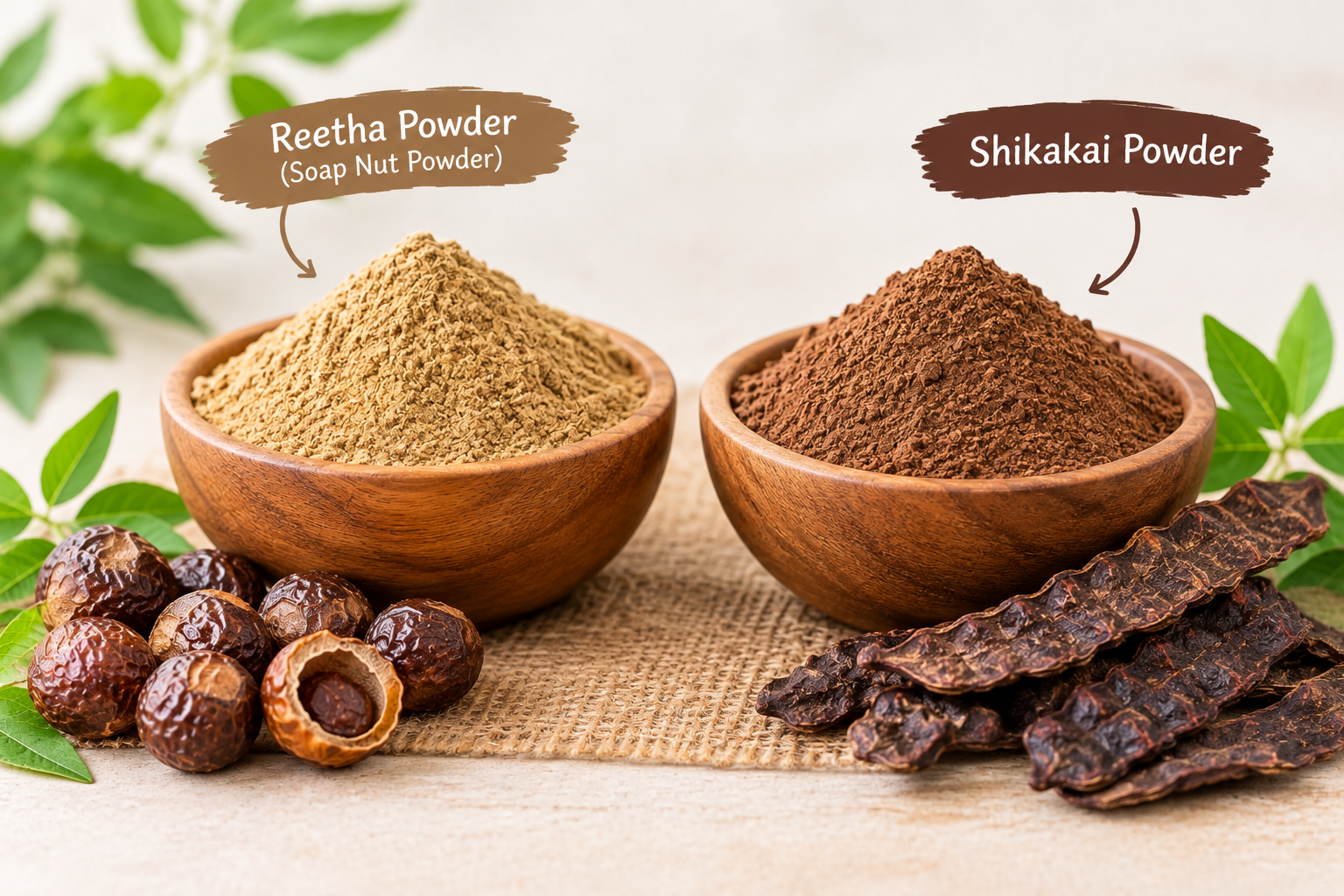
Reetha and shikakai are two well-known ingredients in traditional Indian hair-care routines. Both are commonly used in herbal hair-cleansing preparations, but they are different botanical ingredients with distinct characteristics.
If you're exploring traditional alternatives to conventional hair-care products, you may be wondering whether reetha or shikakai is the better choice. The answer depends on your hair-care preferences, scalp sensitivity, and how you intend to use each powder.
In this guide, we'll explain what reetha and shikakai are, compare their traditional uses, discuss how to prepare them, and help you understand what to consider before choosing one for your routine.
What Is Reetha Powder?
Reetha, also known as soapnut, is the fruit of plants from the Sapindus genus. Its fruit contains naturally occurring saponins, compounds that can produce a lather when mixed with water.
Because of these cleansing properties, reetha has traditionally been used in hair-washing preparations.
Reetha powder is made by processing the dried fruit into a powdered form. Depending on the product, it may be used to prepare a cleansing paste or another rinse-off hair-care preparation.
Traditional use: Reetha is primarily associated with cleansing.
Before purchasing, check the product label to confirm the intended use and preparation instructions.
What Is Shikakai Powder?
Shikakai is a traditional Indian hair-care ingredient obtained from plants commonly identified with the Acacia concinna name. Its pods have historically been used in hair-cleansing preparations.
Shikakai powder is a powdered form used in some traditional hair-washing routines. It can be prepared with water according to the product's directions and used as part of a rinse-off hair-care process.
Shikakai is often chosen by people interested in botanical hair-cleansing ingredients.
Traditional use: Shikakai is associated with hair cleansing and traditional hair-care routines.
As with reetha, check the ingredient information and the manufacturer's instructions before use.
Reetha vs. Shikakai: Key Differences
Although both ingredients are traditionally used for hair cleansing, they are not identical.
| Feature | Reetha Powder | Shikakai Powder |
| Common name | Soapnut | Shikakai |
| Botanical association | Sapindus genus | Commonly associated with Acacia concinna |
| Traditional use | Hair-cleansing preparations | Hair-cleansing preparations |
| Characteristic | Contains naturally occurring saponins | Traditionally used in botanical hair-washing preparations |
| Common preparation | Water-based cleansing mixture, following product directions | Water-based cleansing mixture, following product directions |
| Best choice depends on | Intended use, product instructions, and individual tolerance | Intended use, product instructions, and individual tolerance |
The exact composition and performance of each powder can vary with its source and processing. Neither ingredient should be assumed to work better for every person.
Which Is Better: Reetha or Shikakai?
There is no universal winner. A practical way to choose is to consider what you want from your hair-care routine.
Choose reetha if you're exploring traditional cleansing ingredients
Reetha is traditionally used in cleansing preparations because its fruit contains saponins. If you want to explore soapnut-based hair washing, look for a product labelled for that purpose and follow its directions.
Choose shikakai if you prefer traditional herbal hair-washing preparations
Shikakai has a long history of use in traditional hair-care routines. It may suit people who want to experiment with a botanical cleansing preparation, provided they use it according to the manufacturer's instructions.
Consider your scalp and hair's response
The most appropriate option depends on how your scalp and hair respond to the preparation. A botanical ingredient can still cause irritation, dryness, or sensitivity.
Start cautiously with a product intended for external hair care. If a preparation causes discomfort or leaves your hair feeling excessively dry, discontinue use rather than assuming that continued use will improve the result.
Our practical takeaway: Instead of assuming that one powder is always better, choose based on the product's intended use, the preparation method, and your individual tolerance.
Can You Use Reetha and Shikakai Together?
Reetha and shikakai are sometimes combined in traditional hair-cleansing preparations. Some people prefer using a combination rather than choosing only one ingredient.
However, combining powders does not automatically make a preparation more effective. The result depends on the ingredients, their proportions, the product formulation, and how the mixture is used.
If you want to try both together:
- Check the intended use and instructions on both products.
- Confirm that both are suitable for external hair care.
- Follow the manufacturer's recommended preparation method.
- Prepare only a small quantity.
- Avoid contact with your eyes.
- Rinse thoroughly and discontinue use if irritation develops.
Do not invent a fixed mixing ratio or application time when the manufacturer has not provided one.
Reetha and Shikakai Hair-Care Combo
How to Use Reetha or Shikakai Powder for Hair
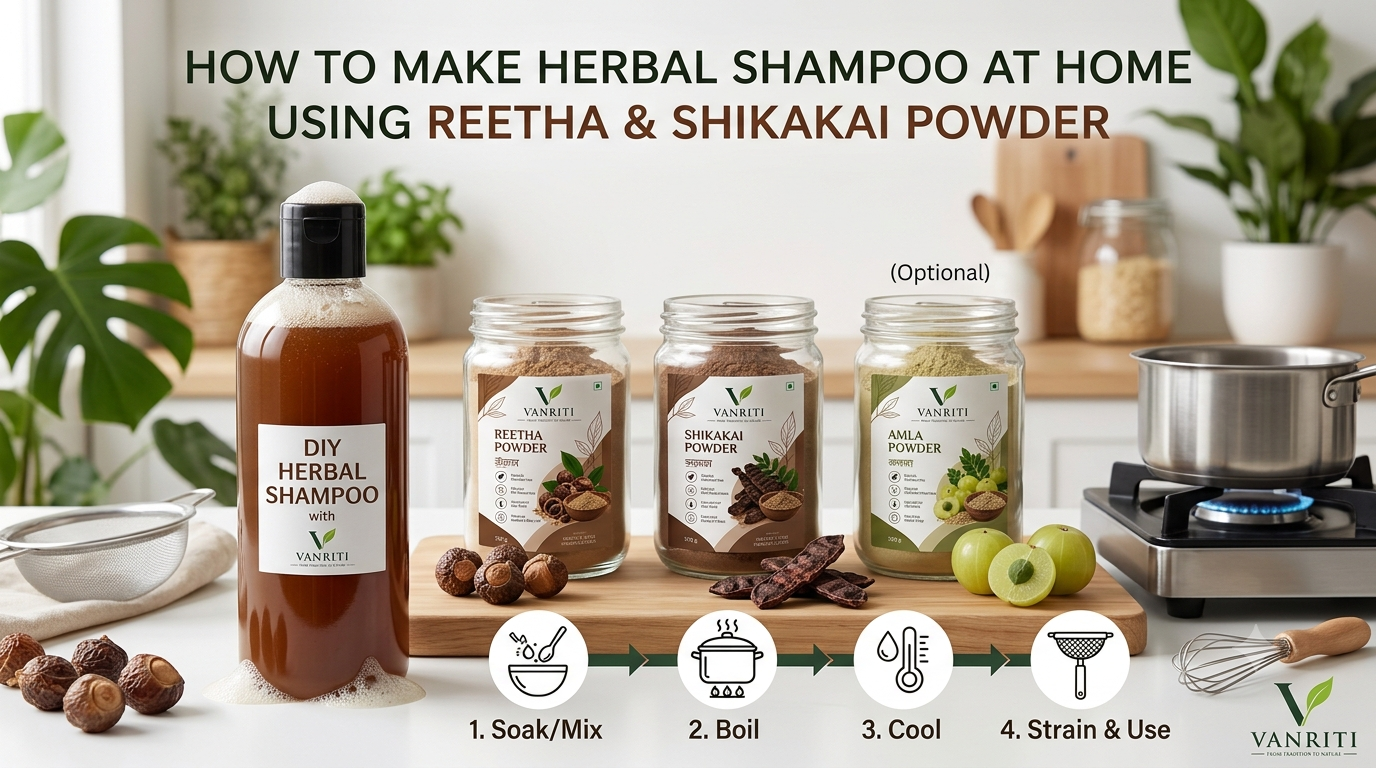
The preparation method depends on the specific product. If the powder is labelled for external hair care and the manufacturer permits a water-based preparation, the following general approach may be suitable.
Step 1: Read the product label
Check the recommended preparation method, application instructions, and any warnings before starting.
Step 2: Measure the powder
Use a clean, dry utensil to measure the amount specified by the manufacturer.
Step 3: Prepare the mixture
Add water gradually if the product instructions call for it. Mix until the preparation reaches the recommended consistency.
Step 4: Apply as directed
Apply the preparation carefully to the areas specified by the label. Avoid contact with your eyes and do not apply it to broken or irritated skin.
Step 5: Rinse thoroughly
Rinse the hair and scalp according to the manufacturer's instructions. Make sure no unwanted powder residue remains.
Step 6: Observe your hair and scalp
Discontinue use if you experience burning, itching, redness, or other irritation.
Use only the application frequency and duration recommended for the specific product.
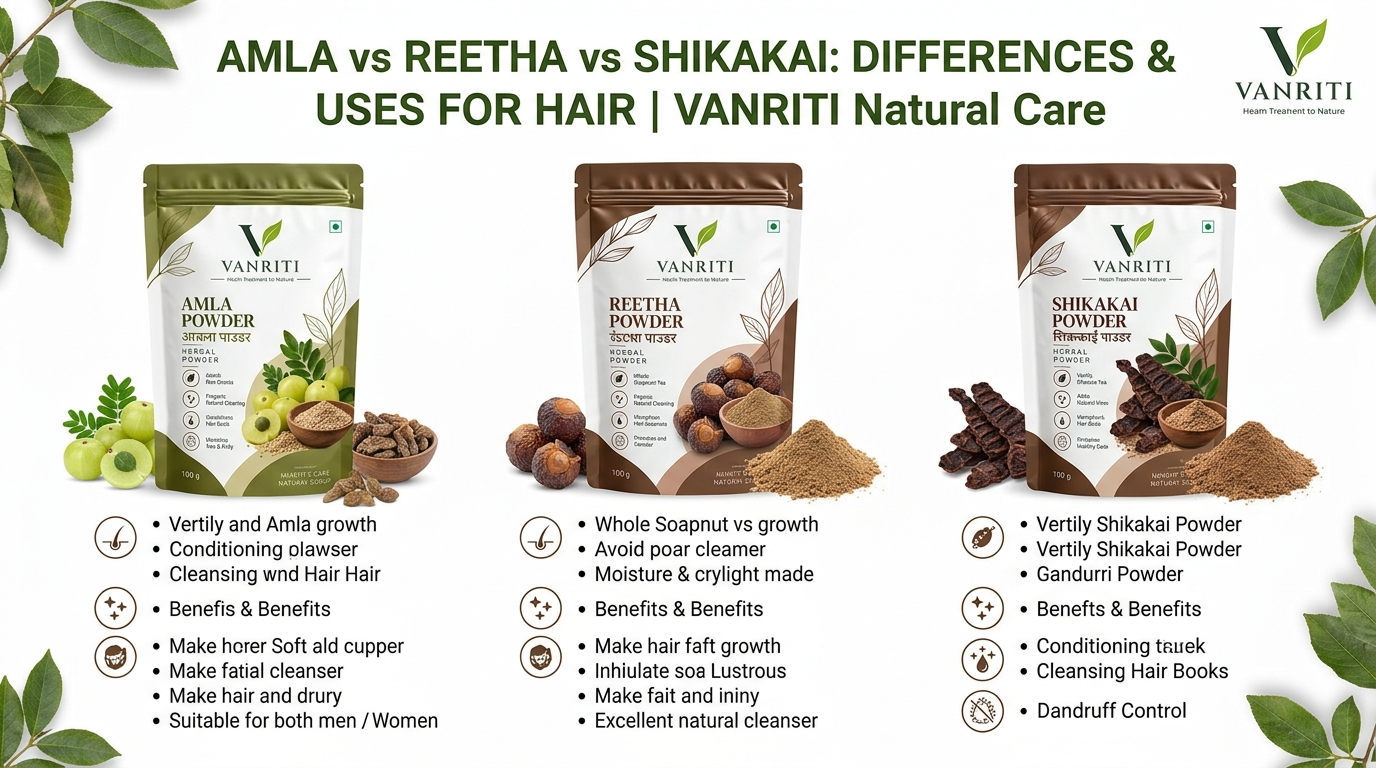
Reetha vs. Shikakai vs. Amla: What Is the Difference?
Amla is another popular ingredient in traditional Indian hair care, but it is commonly used for different purposes from reetha and shikakai.
| Ingredient | Traditional hair-care role |
| Reetha | Hair-cleansing preparations |
| Shikakai | Hair-cleansing preparations |
| Amla | Hair masks and other botanical hair-care preparations |
These traditional roles can overlap in some formulations, but the ingredients are not interchangeable. Check the product instructions to understand the intended application.
Amla Powder for Hair: Benefits, Uses and How to Use It
How to Choose a Good Reetha or Shikakai Powder
Before buying a hair-care powder, review the following points.
1. Check the intended use
Choose a product specifically labelled for the application you have in mind. Do not assume a powder intended for one purpose is automatically appropriate for another.
2. Review the ingredient declaration
Check the listed ingredients and any additional components. Avoid claims about organic status, purity, or additive-free composition unless these are documented by the manufacturer.
3. Follow the usage instructions
The recommended preparation method, duration, and frequency may differ by product. Follow the actual label rather than relying on a generic online recipe.
4. Check packaging and storage
Look for clear net-weight information, manufacturer details, batch information, and storage guidance where applicable. Keep the product protected from moisture and contamination.
5. Consider your personal care preferences
Think about whether you prefer a single ingredient or a combination. A simple routine can make it easier to assess how your hair and scalp respond.
Shop VANRITI Hair Care Products
Precautions When Using Reetha and Shikakai
Traditional hair-cleansing powders require careful handling.
- Perform a patch test before first use.
- Follow the product's instructions for preparation and application.
- Avoid contact with eyes, as these preparations may cause irritation.
- Do not apply to broken, irritated, or inflamed skin.
- Rinse thoroughly after use.
- Stop using the product if you experience irritation or discomfort.
- Keep powders dry and store them according to the label.
- Do not ingest products unless they are explicitly labelled for food use.
If you experience persistent scalp irritation or ongoing hair loss, consult a qualified healthcare professional rather than relying on cleansing powders as treatment.
Frequently Asked Questions
1. What is the main difference between reetha and shikakai?
Reetha, or soapnut, comes from plants in the Sapindus genus and contains naturally occurring saponins. Shikakai is a traditional hair-care ingredient commonly associated with Acacia concinna. Both are used in traditional hair-cleansing preparations.
2. Is reetha better than shikakai for hair?
Neither is universally better. The right choice depends on the product, how it is prepared, and your hair and scalp's response.
3. Can I mix reetha and shikakai powder?
Some traditional preparations combine them. Check both product labels and follow the manufacturer's directions before combining powders.
4. Can I use reetha or shikakai every day?
Do not assume daily use is suitable. Follow the product instructions and monitor your scalp and hair for dryness or irritation.
5. Can reetha or shikakai stop hair fall?
Neither should be promoted as a proven treatment for hair loss. Hair shedding can have many causes, and persistent or sudden hair loss should be assessed by a qualified healthcare professional.
6. Is shikakai a shampoo?
Shikakai is a botanical ingredient traditionally used in hair-cleansing preparations. A powdered product is not necessarily equivalent to a formulated commercial shampoo; follow its specific preparation and use instructions.
7. Can I use reetha and shikakai with amla powder?
Some traditional routines use these ingredients together, but suitability depends on the specific products and their instructions. Confirm that each is intended for external use and patch-test any new preparation.
Conclusion
Reetha and shikakai are both traditional ingredients used in Indian hair-cleansing routines, but they have different botanical origins and product characteristics.
Reetha is associated with soapnut-based cleansing preparations, while shikakai is another established ingredient in traditional herbal hair washing. Rather than assuming one is best for everyone, consider the product's intended use, follow its instructions, and pay attention to your scalp's response.
If you're building a botanical hair-care routine, exploring individual powders and suitable combinations can help you make more informed choices.