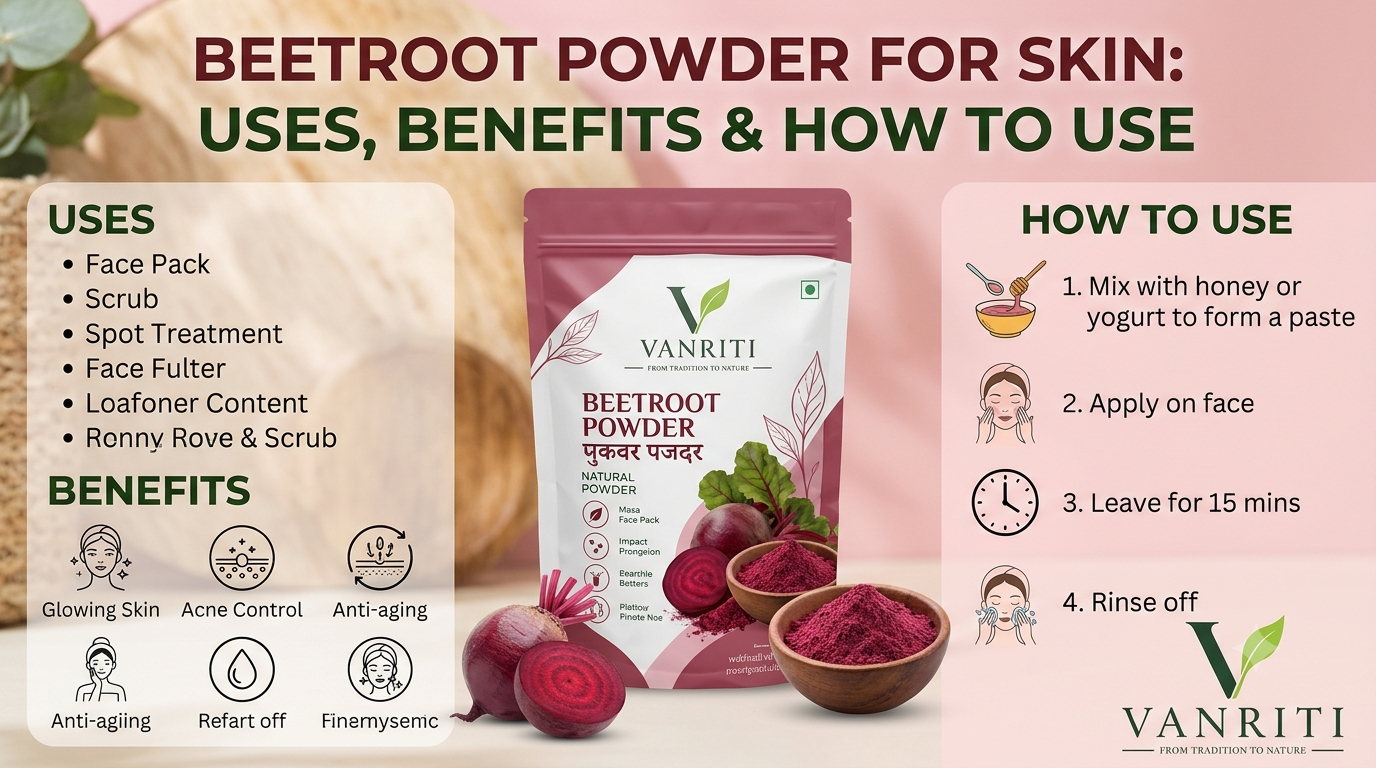
Natural skincare has become increasingly popular among people who prefer simple ingredients and homemade beauty preparations. From multani mitti and neem powder to aloe vera and beetroot, plant-based ingredients are commonly included in traditional skincare routines.
Among these ingredients, beetroot powder for skin is gaining attention as a convenient way to include beetroot in homemade face packs.
Made from dried and powdered beetroot, this colourful ingredient can be mixed with suitable liquids to prepare simple face masks. It is often chosen for its natural reddish-pink colour and its use in traditional beauty preparations.
But how should you use beetroot powder on your face? Can you combine it with multani mitti? Which skin types should be careful when using it?
In this blog, we will explore the uses of beetroot powder, easy homemade face-pack recipes, application methods and important precautions.
2. What Is Beetroot Powder?
Beetroot powder is made by drying beetroot and grinding it into a fine powder. Beetroot is known for its deep red-purple colour, which comes from naturally occurring pigments called betalains.
It is commonly used in food preparations and can also be included in certain cosmetic preparations.
In skincare routines, beetroot powder is generally mixed with ingredients such as water, aloe vera gel or other suitable cosmetic ingredients to prepare homemade face packs.
Why do people use beetroot powder for skincare?
- It is a plant-derived ingredient.
- It has a naturally rich colour.
- It can be mixed into homemade face-pack preparations.
- It can be combined with other suitable cosmetic ingredients.
- It is convenient to store and use in dry powder form.
Always check whether the beetroot powder you purchase is specifically intended for cosmetic use before applying it to your face.
3. Beetroot Powder for Skin: Uses and Traditional Benefits
Beetroot powder is used in some homemade skincare preparations because of its natural colour and plant-based composition.
Here are some common reasons people include it in their skincare routines.
1. Useful for Homemade Face Packs
Beetroot powder can be mixed with water or another suitable ingredient to prepare a simple face pack.
Its fine powder form makes it convenient for creating different homemade skincare mixtures.
2. Contains Naturally Occurring Plant Pigments
Beetroot contains betalains, which give it its characteristic red-purple colour. These pigments are also studied for their antioxidant properties.
However, this does not mean that applying beetroot powder directly to the face has proven anti-ageing or skin-treatment effects.
3. Can Be Combined with Other Skincare Ingredients
Beetroot powder can be combined with suitable ingredients such as multani mitti or aloe vera gel to prepare different face-pack textures.
The ingredients should be selected according to individual skin tolerance and their intended cosmetic use.
4. Convenient for DIY Skincare Preparations
Unlike fresh beetroot, which needs to be washed, cut and prepared, beetroot powder is ready to mix.
This makes it a convenient option for people interested in preparing simple face packs at home.
4. How to Use Beetroot Powder on Face
Using beetroot powder in a homemade face pack is simple. The most important thing is to prepare a smooth mixture and avoid applying an excessively thick layer.
Follow these basic steps:
- Take a small quantity of cosmetic-grade beetroot powder in a clean bowl.
- Add a little water gradually.
- Mix until you get a smooth paste.
- Clean your face with a gentle cleanser.
- Apply a thin, even layer while avoiding the eyes and lips.
- Follow a short application time according to your skin's tolerance.
- Rinse gently with lukewarm or normal water.
- Apply a suitable moisturiser afterwards.
Important: Perform a patch test before using a new preparation on your face. Beetroot's natural pigment may temporarily stain skin, nails, clothing or towels.
5. Three Easy Homemade Beetroot Powder Face-Pack Recipes
Here are three simple ways to include beetroot powder in a homemade skincare routine.
Recipe 1: Simple Beetroot Powder Face Pack
Ingredients:
- 1 teaspoon beetroot powder
- Water as required
Preparation:
- Take beetroot powder in a clean bowl.
- Add water little by little.
- Mix until a smooth paste forms.
- Apply a thin layer to clean skin.
- Rinse gently after a short application period.
Why try this recipe?
This is a simple preparation for anyone who wants to try beetroot powder without combining multiple ingredients.
Recipe 2: Beetroot Powder and Multani Mitti Face Pack
Ingredients:
- 1 teaspoon beetroot powder
- 1 teaspoon multani mitti
- Water as required
Preparation:
- Combine beetroot powder and multani mitti in a bowl.
- Add water gradually.
- Mix until the ingredients form a smooth paste.
- Apply gently to the face, avoiding the eye area.
- Rinse before the mixture becomes uncomfortably dry.
Why try this recipe?
Multani mitti is traditionally used in face packs for its absorbent properties. Combining it with beetroot powder creates a simple homemade clay-based preparation.
People with dry or sensitive skin should be particularly careful, as clay-based preparations may feel drying.
Recipe 3: Beetroot Powder and Aloe Vera Face Pack
Ingredients:
- 1 teaspoon beetroot powder
- 1 teaspoon plain aloe vera gel suitable for facial use
Preparation:
- Take beetroot powder in a clean bowl.
- Add aloe vera gel.
- Mix until you get a smooth consistency.
- Apply a thin layer to clean skin.
- Rinse gently after a short application period.
Why try this recipe?
Aloe vera gel is commonly included in cosmetic preparations because of its lightweight gel texture. It can help create a smooth, easy-to-apply face pack.
Use only aloe vera gel that is suitable for facial application and does not contain ingredients to which you are sensitive.
6. Which Skin Types Can Use Beetroot Powder?
Not every ingredient suits every skin type. Before including beetroot powder in your routine, consider your skin's individual needs.
| Skin Type | Things to Consider |
| Oily Skin | A simple water-based preparation may be easier to try. Avoid overusing clay-based combinations. |
| Dry Skin | Choose a preparation that does not leave your skin feeling tight or uncomfortable. |
| Combination Skin | Start with a small amount and observe how different areas of your face respond. |
| Sensitive Skin | Be extra cautious and perform a patch test. Avoid combining multiple new ingredients. |
| Normal Skin | Start with a simple preparation and monitor your skin's response. |
If you have a known skin allergy or a skin condition, consult a qualified dermatologist before experimenting with homemade face packs.
7. How Often Should You Use Beetroot Powder on Your Face?
There is no scientifically established ideal frequency for using homemade beetroot powder face packs.
If you decide to try one, start with occasional use rather than applying it every day.
Keep the following points in mind:
- Begin with a small amount.
- Avoid using multiple new face packs at the same time.
- Do not scrub your face aggressively.
- Stop using the preparation if irritation develops.
- Follow your regular skincare routine, including moisturiser and sunscreen.
Your skin's comfort should always be more important than following a fixed DIY skincare schedule.
8. Common Mistakes to Avoid When Using Beetroot Powder
Although beetroot powder is a plant-derived ingredient, incorrect use can cause an unpleasant skincare experience.
Avoid these common mistakes:
1. Applying too much powder: A thick paste can be difficult to spread and remove. Start with a small quantity.
2. Skipping the patch test: Natural ingredients can still cause allergic reactions or irritation.
3. Mixing too many ingredients: Start with one or two suitable ingredients instead of experimenting with several at once.
4. Leaving the face pack on for too long: Longer application does not guarantee better results. Rinse if your skin feels uncomfortable.
5. Scrubbing aggressively: Avoid rubbing the face while applying or removing the pack.
6. Using food-grade powder without checking its intended use: Choose a product specifically suitable for cosmetic application.
7. Storing leftover wet mixtures: Prepare a fresh mixture for each application and discard leftovers.
9. Precautions Before Using Beetroot Powder for Skin
Before including beetroot powder in your skincare routine, remember these important precautions.
- Always perform a patch test before first use.
- Avoid applying the mixture near the eyes.
- Do not apply it to cuts, wounds or irritated skin.
- Avoid using it if you have a known allergy to beetroot.
- Check the product label for ingredients and intended use.
- Do not assume that natural ingredients are suitable for everyone.
- Stop use if you notice redness, itching, burning or discomfort.
- Keep dry powder in a clean, tightly closed container away from moisture.
- Prepare wet face packs fresh instead of storing them.
If irritation is severe or persistent, seek advice from a dermatologist.
10. How to Choose Good-Quality Beetroot Powder
Choosing a suitable product is just as important as preparing it correctly.
Before purchasing beetroot powder, consider these points:
Check the Ingredient Label
Look for clear ingredient information and check whether the product contains only beetroot powder or additional ingredients.
Check the Intended Use
Choose a product specifically labelled for cosmetic use if you intend to apply it to your face.
Check Packaging
Prefer properly sealed packaging that protects the powder from moisture and contamination.
Check Manufacturing and Expiry Details
Always check batch information, manufacturing details, expiry date and storage instructions.
Read Product Information Carefully
Do not rely only on claims such as instant glow, whitening or pigmentation removal. Look for clear product information and realistic descriptions.
11. Beetroot Powder vs Multani Mitti: What's the Difference?
Both ingredients are used in homemade face packs, but they have different properties and traditional applications.
| Feature | Beetroot Powder | Multani Mitti |
| Source | Dried beetroot | Naturally occurring clay |
| Appearance | Red to pinkish-purple | Usually light brown or beige |
| Traditional Use | Homemade skincare preparations | Clay-based face packs |
| Common Preparation | Mixed with water or suitable gel | Mixed with water or suitable liquid |
| Main Characteristic | Naturally occurring plant pigments | Absorbent clay properties |
You can explore both ingredients to understand which type of preparation is more suitable for your skincare routine.
12. Frequently Asked Questions (FAQs)
Q1. Is beetroot powder good for skin?
Beetroot powder is a plant-derived ingredient used in some homemade skincare preparations. It can be mixed with suitable ingredients to make face packs. However, there is limited clinical evidence that applying beetroot powder to the skin produces specific cosmetic or therapeutic results.
Q2. How do I use beetroot powder on my face?
Mix a small quantity of cosmetic-grade beetroot powder with water to create a smooth paste. Apply a thin layer, avoiding the eyes, and rinse gently after a short period. Always patch-test first.
Q3. Can I use beetroot powder with multani mitti?
Yes, you can prepare a simple mixture using beetroot powder and multani mitti. Add water gradually to create a smooth paste. However, people with dry or sensitive skin should be cautious because multani mitti may feel drying.
Q4. Can beetroot powder remove pigmentation?
There is insufficient clinical evidence to establish that applying beetroot powder removes pigmentation or dark spots. For persistent pigmentation concerns, consult a dermatologist and use evidence-based skincare.
Q5. Can I use beetroot powder every day?
Daily use is not necessary. Start with occasional use and observe how your skin responds. Stop if you experience irritation or discomfort.
Q6. Does beetroot powder stain the face?
Beetroot contains natural red-purple pigments that may temporarily stain the skin. The colour may also transfer to towels, clothing or other surfaces.
Q7. Can I mix beetroot powder with aloe vera gel?
You can prepare a simple mixture using cosmetic-grade beetroot powder and suitable aloe vera gel. Perform a patch test first and check the aloe vera product's ingredient list.
Q8. Can sensitive skin use beetroot powder?
People with sensitive skin should be cautious. Perform a patch test before facial application and avoid using it if irritation develops.
13. Conclusion
Beetroot powder is a convenient plant-based ingredient that can be included in simple homemade skincare preparations.
Whether you choose a basic beetroot face pack, combine it with multani mitti or mix it with suitable aloe vera gel, the key is to keep your skincare routine simple and pay attention to your skin's response.
Always choose cosmetic-grade ingredients, perform a patch test and follow appropriate application and storage practices.
If you enjoy exploring traditional plant-based skincare ingredients, beetroot powder and multani mitti can be considered as options for homemade face-pack preparations.
Explore VANRITI's range of herbal powders and discover simple ways to include traditional ingredients in your skincare routine.