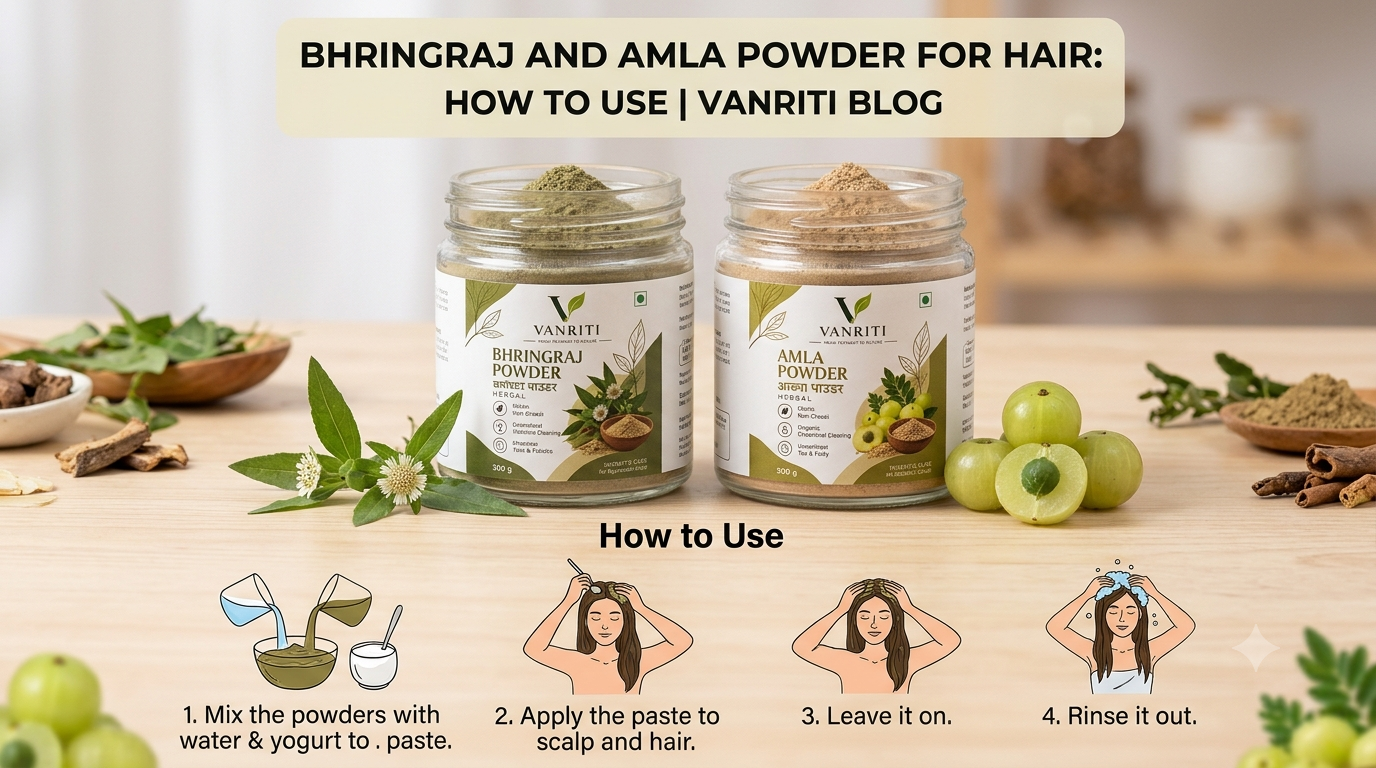
Amla and bhringraj are two well-known ingredients in traditional Indian hair-care practices. Both are commonly used in homemade herbal preparations and are available in powdered form, making them convenient ingredients for people interested in plant-based personal-care routines.
Amla is traditionally included in hair masks and herbal blends, while bhringraj is also used in traditional hair-care preparations. When combined, the two powders can be mixed with water to create a simple homemade hair mask.
But how do you prepare this combination? How should you apply it? Can it be used on different hair types?
In this guide, we will explore the traditional uses of bhringraj and amla powder for hair, explain how to prepare a simple hair mask, and share practical application and safety tips.
1. What Is Amla Powder?
Amla, commonly known as Indian gooseberry, comes from the fruit of the amla plant (Phyllanthus emblica).
It is widely recognised in traditional Indian personal-care practices and is commonly used in homemade hair masks and herbal preparations.
Amla powder is made by drying and grinding the fruit into a fine powder. It can be mixed with water or other suitable ingredients to create a paste.
Traditional Uses of Amla Powder
- Used in homemade herbal hair masks.
- Combined with other traditional hair-care powders.
- Included in personal-care preparations.
- Used as an ingredient in traditional hair-care routines.
If you are trying amla powder for the first time, start with a simple preparation and follow the manufacturer's instructions.
2. What Is Bhringraj Powder?
Bhringraj is a botanical ingredient traditionally used in Indian hair-care preparations. It is commonly associated with the plant Eclipta prostrata, also known in some references as Eclipta alba.
Bhringraj powder is generally prepared by drying and grinding the plant material. The exact plant part and botanical identification may vary by product, so check the ingredient details on the packaging.
Traditional Uses of Bhringraj Powder
- Used in homemade hair masks.
- Combined with amla and other herbal powders.
- Included in traditional hair-care preparations.
- Used by people who prefer botanical ingredients in their personal-care routine.
Bhringraj powder should be used according to its intended cosmetic application and the manufacturer's directions.
3. Why Are Amla and Bhringraj Used Together?
Amla and bhringraj are often combined in traditional hair-care preparations because both are familiar ingredients in herbal personal care.
Using them together provides a simple way to prepare a two-ingredient hair mask.
| Ingredient | Traditional hair-care use |
| Amla powder | Commonly used in homemade hair masks and herbal blends |
| Bhringraj powder | Traditionally included in hair-care pastes and preparations |
Some people prefer using both powders together, while others use them separately.
There is no need to combine them if one ingredient already suits your routine. Introducing one ingredient at a time can also make it easier to identify the cause if irritation occurs.
Important: Traditional use does not prove that this combination can guarantee hair growth, prevent hair fall or reverse premature greying. Individual results and suitability vary.
4. How to Make a Bhringraj and Amla Hair Mask at Home
A simple homemade hair mask can be prepared using these two powders and water.
Ingredients
- 1 tablespoon amla powder
- 1 tablespoon bhringraj powder
- Water as required
These quantities are a starting point for a small preparation. Adjust according to your hair length and the product instructions.
Preparation Method
Step 1: Take a clean bowl.
Use a clean, dry bowl and spoon to prepare the mixture.
Step 2: Add the powders.
Measure the amla and bhringraj powders into the bowl.
Step 3: Mix the ingredients.
Stir the two powders together until they are evenly combined.
Step 4: Add water gradually.
Pour in a little water at a time while mixing. Continue until you get a smooth, spreadable paste.
Step 5: Allow the mixture to rest briefly.
Let the paste stand for a short time if the product instructions permit, then stir again.
Step 6: Prepare a fresh batch.
Make only the quantity you need for one application. Do not store leftover wet paste unless the product is specifically formulated and labelled for storage after mixing.
How to Apply the Hair Mask
- Read the instructions on both powder packages.
- Divide your hair into manageable sections.
- Apply the paste gently to your hair and scalp only if both products are intended for that use.
- Avoid vigorous rubbing.
- Keep the mixture away from your eyes.
- Follow the recommended application time.
- Rinse thoroughly with clean water.
- Use a suitable conditioner if your hair needs it.
If you experience burning, itching or irritation, rinse immediately and discontinue use.
5. How to Use Amla and Bhringraj Separately
You do not always need to combine both powders. They can also be used individually in simple preparations.
Amla Powder Hair Mask
Ingredients:
- A small quantity of amla powder
- Water as required
Method:
- Add amla powder to a clean bowl.
- Gradually add water.
- Mix until a smooth paste forms.
- Apply according to the product instructions.
- Rinse thoroughly after the recommended time.
Bhringraj Powder Hair Mask
Ingredients:
- A small quantity of bhringraj powder
- Water as required
Method:
- Place bhringraj powder in a clean bowl.
- Add water gradually.
- Stir to prepare a smooth paste.
- Apply only if the product is intended for cosmetic hair use.
- Follow the manufacturer's application instructions.
- Rinse thoroughly.
Trying the ingredients separately can help you understand how each one suits your hair and scalp.
6. Is the Amla and Bhringraj Hair Mask Suitable for Every Hair Type?
Not necessarily. Different hair types may respond differently to the same preparation.
| Hair type | What to consider |
| Dry hair | Check whether the mask leaves hair feeling rough; use a suitable conditioner if needed |
| Oily scalp | Avoid applying more frequently than the product instructions recommend |
| Normal hair | Consider occasional use if the ingredients suit your routine |
| Curly hair | Apply gently and rinse carefully to minimise tangling |
| Fine hair | Use a manageable quantity and rinse thoroughly |
| Sensitive scalp | Introduce cautiously and stop if irritation occurs |
If you have dry, damaged or chemically treated hair, pay particular attention to how your hair feels after rinsing.
A homemade herbal mask does not replace a conditioner or a product formulated for specific hair needs.
7. How Often Should You Use Amla and Bhringraj Powder?
There is no universal application schedule for every person.
Frequency depends on:
- The product's instructions.
- Your hair type and scalp condition.
- How your hair responds after application.
- Whether you use other hair-care products.
- Whether you experience dryness or irritation.
If you are new to the combination, begin with occasional use if permitted by the product instructions.
Avoid assuming that daily application or longer application times will produce better results.
8. Can You Add Hibiscus Powder to Amla and Bhringraj?
Hibiscus is another traditional botanical ingredient used in homemade hair masks.
Some people prefer combining hibiscus with amla or bhringraj. However, adding several ingredients at once is not necessary.
If you want to explore a three-ingredient preparation:
- Start by checking the intended use of all three products.
- Introduce the ingredients separately first.
- Use small quantities.
- Prepare a fresh mixture.
- Stop if irritation or discomfort develops.
For beginners, a simple two-ingredient mixture is easier to assess.
9. Common Mistakes to Avoid
When using amla and bhringraj powder, avoid these common mistakes:
Using too much powder: Begin with a small quantity and adjust according to your hair length.
Adding too much water: A very runny mixture may be difficult to apply.
Mixing too many ingredients: Start with a simple preparation so you can understand how your hair responds.
Leaving the mask on too long: Follow the manufacturer's recommended application time.
Applying without testing: Herbal ingredients can still cause irritation or allergic reactions.
Rinsing inadequately: Leftover powder may make your hair feel gritty.
Storing wet paste: Prepare only what you need for one application.
Expecting guaranteed results: These powders are not guaranteed treatments for hair growth, hair fall or scalp disorders.
10. Safety Tips Before Using Amla and Bhringraj Powder
Natural ingredients are not automatically suitable for everyone.
Follow these precautions:
- Check the complete ingredient list.
- Confirm that both powders are intended for cosmetic hair care.
- Follow the manufacturer's preparation and application directions.
- Perform a patch test according to the product instructions.
- Avoid applying the mixture to irritated or broken skin.
- Keep the preparation away from your eyes.
- Stop using it if you notice redness, itching, burning or swelling.
- Store the dry powders according to the manufacturer's instructions.
A patch test cannot guarantee that a reaction will never occur.
If you experience persistent scalp problems or sudden hair loss, consult a qualified healthcare professional.
How to Use Herbal Powders Safely
11. How to Choose Good Quality Amla and Bhringraj Powder
Before purchasing either powder, check the following details:
- Ingredient identification: Confirm the product name and ingredient information.
- Intended use: Ensure it is intended for cosmetic hair care.
- Packaging: Look for a sealed package without visible damage.
- Batch information: Check the relevant batch or lot details.
- Date information: Review the manufacturing and expiry or best-before information.
- Usage instructions: Choose products with clear preparation directions.
- Storage instructions: Follow the manufacturer's guidance.
- Seller information: Look for identifiable manufacturer or seller details.
Do not judge product quality by colour or fragrance alone. Also avoid relying on unsupported claims about guaranteed hair growth or hair-fall prevention.
Conclusion
Amla and bhringraj are two traditional botanical ingredients that can be used together in a simple homemade hair mask. Their powdered form makes them convenient to prepare and include in a personal hair-care routine.
Start with a small quantity, follow the product instructions and observe how your hair and scalp respond. You can use them separately or together, depending on your preferences and product suitability.
Choose clearly labelled products, prepare fresh mixtures and follow basic safety precautions.
Explore VANRITI's herbal hair-care range to discover traditional ingredients for your personal-care routine.
Explore VANRITI Hair Care Products
3. Frequently asked questions (FAQs)
1. Can I mix amla and bhringraj powder together?
Yes, these powders are traditionally combined in homemade hair-care preparations. Check that both products are intended for cosmetic hair use and follow their instructions.
2. How do I use amla and bhringraj powder for hair?
Mix the powders with water to create a smooth paste. Apply according to the product instructions, leave it on for the recommended time and rinse thoroughly.
3. What is the best ratio of amla and bhringraj powder?
Equal quantities are a simple starting point for a small homemade preparation. Adjust the amount according to your hair length and the product directions.
4. Can I use amla and bhringraj powder every day?
Daily use is not necessary for everyone. Follow the manufacturer's instructions and monitor how your hair and scalp respond.
5. Can amla and bhringraj powder prevent hair fall?
There is no guarantee that this combination can prevent hair fall. Persistent or sudden hair loss should be evaluated by a qualified healthcare professional.
6. Can I use this hair mask on dry hair?
You can consider it if both products are suitable for your intended application. However, if the preparation leaves your hair feeling rough or dry, discontinue it and consider a suitable conditioning routine.
7. Can I add hibiscus powder to this combination?
Hibiscus is also traditionally used in hair-care preparations. You can explore it separately before introducing it into a combination.
8. How long should I leave the mask on?
Follow the application instructions on the product packaging. Do not assume that leaving the mask on longer will improve the results.
9. Can I store leftover amla and bhringraj paste?
Prepare only what you need for one application. Do not store leftover wet paste unless the product is specifically formulated and labelled for that purpose.
10. Are amla and bhringraj powders suitable for sensitive scalps?
Not necessarily. Both ingredients may cause irritation in some individuals. Introduce them cautiously, patch test as directed and stop use if a reaction develops.